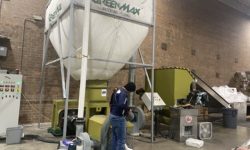
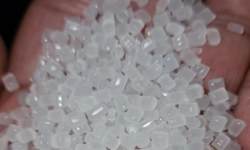
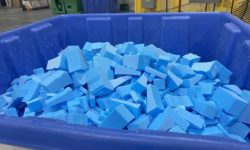
Despite the challenges, EPO foam can still be recycled smoothly. Currently, GREENMAX has successfully helped a partner in the United States to use foam densifier to recycle EPO foam, which not only protects renewable resources, but also reduces the generation of white pollution.
EPO foam is a lightweight, impact-resistant, recyclable material that is widely used in various industrial fields, such as automotive parts, electronic product packaging, sports equipment, and model aircraft. EPO is known for its excellent durability, pressure resistance and chemical resistance, and is more flexible and recyclable than other foam materials such as EPS. However, although EPO has certain recycling potential, EPO recycling work on a global scale still faces technical, economic and market challenges.
EPO foam recycling is very necessary. Although EPO foam is not as easy to break into tiny particles and enter the marine environment as EPS, its non-biodegradability means that if not properly recycled, EPO foam will also cause long-term pollution to the ecosystem. .
EPO foam is based on petroleum-derived polyolefin materials. Recycling EPO can reduce the demand for raw materials, alleviate resource shortages, and reduce greenhouse gas emissions. EPO foam is large in size and takes up a lot of space in landfills. Recycling EPO can effectively alleviate the capacity pressure of landfills.
Although EPO foam is recyclable, the process of recycling this material still presents challenges. EPO foam has low-density characteristics similar to EPS. Although it is lightweight, it is bulky and has low transportation efficiency. Without proper compression equipment, the cost of transporting large amounts of EPO scrap can exceed its recycling value. In addition, the foam's high elasticity makes it more difficult to maintain its compressed shape during the compression process, causing recycling facilities to face additional challenges when storing and transporting it.

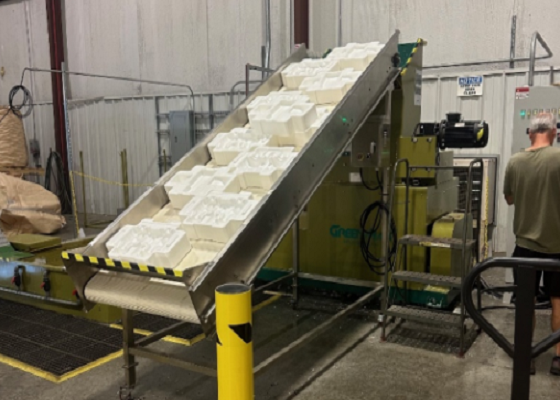
Despite the challenges, EPO foam can still be recycled smoothly. Currently, GREENMAX has successfully helped a partner in the United States to recycle EPO foam, which not only protects renewable resources, but also reduces the generation of white pollution. In order to better compress EPO foam, GREENMAX recommends customers to use hot melt technology for compression. The compression ratio of foam densifier is currently the highest among all compression equipment, and the compression ratio can reach 90:1. First, the EPO foam is put into the crushing bin of the foam densifier, and then crushed, which ensures that it can be heated and melted better in the future. The heated and melted foam can form ingots after natural cooling. This customer wants to achieve better results Automation, using water cooling system with foam densifier, realizes automatic cutting, cooling, transmission, collection and other processes.

Although the recycling of EPO foam faces many technical and economic challenges, it has huge potential. By improving recycling technology, improving infrastructure and enhancing market demand, the recycling rate of EPO can be greatly increased, environmental pollution can be reduced, and the development of a circular economy can be promoted. As global concern about plastic pollution continues to increase, EPO foam recycling will undoubtedly play an even more important role in the future.