
Ban this, ban that... In recent radical activities, because of the pollution, it seems that plastics should be eliminated from the earth first. When there is no viable solution to solve the problem of trying to eliminate plastics, the ban seems to be the driving force. But what if there is an EPS densifier that can solve plastics pollution but not eliminate it, is the plastics ban still prevail?
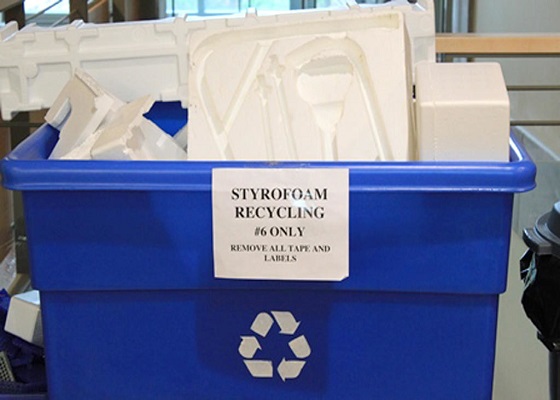
Table of Contents
Take EPS as an example
Let us take the real case of polystyrene foam as an example, which is commonly referred to as EPS. EPS for packaging is an engineering solution that can solve many packaging transportations, safety, and protection issues. EPS is a lightweight material, about 95% to 98% is air, with good insulation properties. It is used for all types of products from beverage cups that keep beverages hot or cold to packaging materials.
Its lightweight can save fuel during transportation, prevent cargo damage, and have low cost. Foam recycling is growing. There is no doubt that even with negative environmental concepts and a large number of ban calls, the use of expanded polystyrene is constantly expanding. Fortunately, the same goes for recycling programs and recycling foam markets.
The EPS industry is beginning to overcome the myth surrounding the material. It can be recycled, and the market for doing so is growing rapidly. In the United States and overseas, especially in China, there is a great demand for recycled EPS materials. However, only 71 million pounds of EPS were recovered in 2010.
The 2012 update found that 31.1% of the US population has access to the EPS foam foodservice item recycling program and 12.2% of the people can recycle EPS packaging shapes. According to the report, the amount of EPS recycling exceeded 118 million pounds. According to data from the EPS Industry Alliance, in the past ten years, the average recovery rate of EPS has reached 15%, one of the highest in the plastic family.
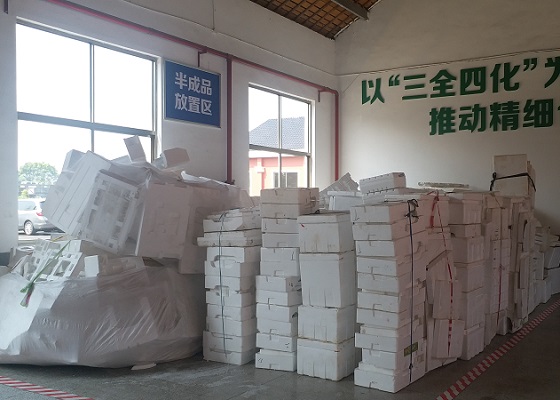
EPS application after recycling
Due to limited opportunities for EPS recycling, it is difficult for some companies to find recycled EPS materials for their raw materials. Recycled EPS foam has three potential uses: most of the internal waste and waste recycling after industry, combined with the original EPS foam, and post-consumer recycled EPS combined with the original EPS or used for non-EPS applications, as an additive for virgin polystyrene and HIPS resin applications.
Independent research by Wilson Jene Consulting of Pittsburgh, Pennsylvania explored the search for potential sources of recyclable EPS materials for consumption in the United States for the third use mentioned above. The PS resin market is significantly larger than the EPS foam market (about 10 times larger). Surprisingly, the sources of recycled EPS are limited. The study found the number of recyclers selling such materials is limited, and many buyers of these materials are located overseas.
Compared with virgin PS, recycled EPS has a lower cost and is usually a high-quality raw material with good physical properties. Since the cost of raw materials usually accounts for 50% to 70% of the total cost of finished products, the availability of low-cost raw materials can enable manufacturers to be competitive in specific applications and markets.
For some highly competitive markets and applications, the availability of low-cost raw materials helps maintain manufacturing in the United States. So, what prevents the use of this demand? Going back to the mentioned EPS foam, one of the reasons is 95% to 98% air. One cannot economically transport the bulky foam from location A to location B. Or is it possible?
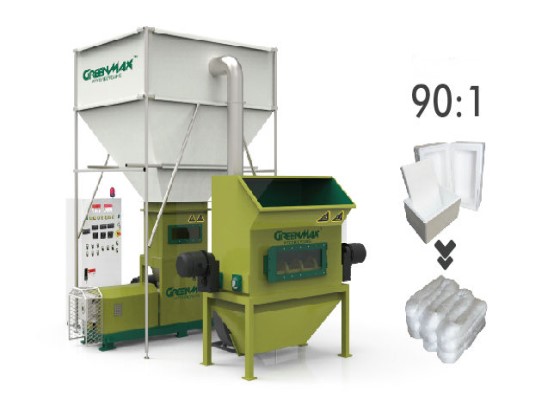
EPS densifier help provide recycling solutions
The solution is a process called foam densifier, which can increase the density of EPS foam by 50 to 90 times. A complete 53-foot trailer loaded with loosely stacked EPS foam usually weighs about 2,000 pounds, or compacted EPS foam processed by a styrofoam compactor can be loaded and transported as a conventional 40,000-pound truck. EPS foam recycling equipment can usually recover its costs within two years in this way.
By reducing waste collection costs and landfill dumping costs, significant savings; and further conversion from selling densified materials and its injection molding or extrusion methods. GREENMAX is an expert in foam recycling. The mars series of GREENMAX foam recycling machines reduce the volume of foam waste through high-volume extrusion technology. Find the EPS foam densifier that meets your needs.