
The 2024 Olympic Games began with everyone's expectations. The objective of the Organizing Committee for the Paris 2024 Olympic Games is ambitious: compared to the previous one, it plans to halve the carbon emissions of the competition. We develop plans for each emission source and engage all relevant parties to demonstrate new operating models. In addition to reducing its impact on the climate, the organizing committee wants to be more daring in offsetting emissions produced by the competition by supporting projects that provide environmental benefits. Mitigating the impact of carbon emissions on the climate is also what deserves the most attention in this competition.
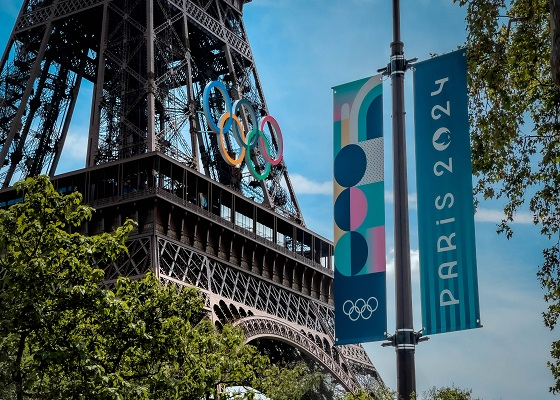
To achieve this ambitious objective, the entire process goes through five stages: predict - avoid - reduce - compensate - mobilize. When it comes to reducing carbon emissions, it is a common goal that all walks of life are striving to achieve. Among them, reducing carbon emissions through EPS recycling has attracted widespread attention in recent years. After recycling, EPS can be reprocessed and reused.
Without recycling, new polystyrene raw materials typically must be expanded to produce new EPS, a process that consumes large amounts of energy and fossil fuels, releasing large amounts of carbon dioxide and other gases greenhouse. Recycling EPS reduces the need for new polystyrene, thereby reducing carbon emissions from new production processes. If EPS are not recycled but instead disposed of in landfills, they will eventually decompose and release greenhouse gases such as methane. Methane, produced by the decomposition of organic waste in landfills in an anoxic environment, is a very potent greenhouse gas, with a greenhouse effect approximately 25 times that of carbon dioxide.
Therefore, reducing EPS going to landfill can significantly reduce this type of greenhouse gas emissions. Over the past ten years, GREENMAX has insisted on EPS recycling, effectively contributing to reducing carbon emissions. In fact, the whole model for recycling EPS is similar to the Olympic ideas for reducing emissions. GREENMAX primarily focuses on clearing this connection, what we often call turning trash into treasure.
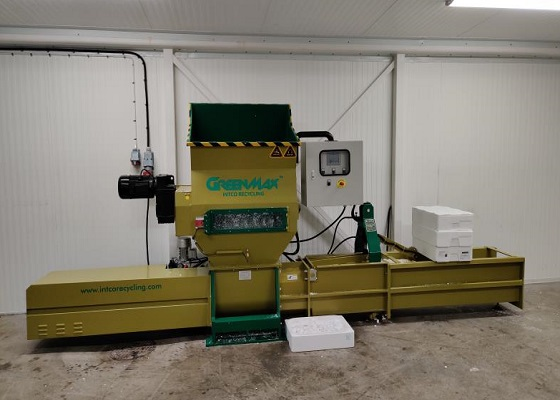
To better recycle EPS, GREENMAX designs and manufactures different types of machines for recycling EPS. The main objective of these devices is to contribute to volume reduction. The EPS recycling machine most commonly used in France and Europe is the EPS compactor. This is a device fully supported by cold press technology. The process does not require heating, enabling truly energy-efficient recycling and converting electrical energy into electrical energy.
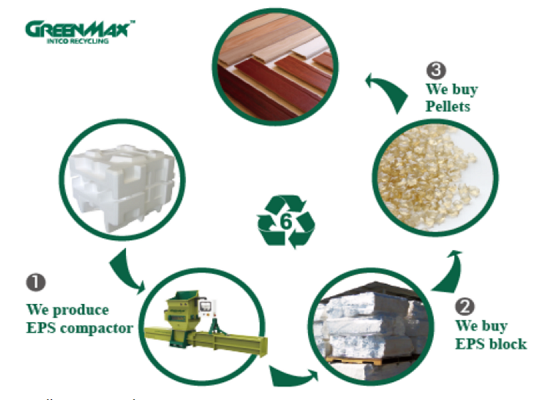
The foam blocks compressed by the EPS compactor become compact and the volume is one-fifth of the original size, effectively reducing the number of transportation times during transportation and reducing vehicle exhaust emissions. These compressed EPS will be combined in various ways with new materials to be transformed into new plastic products. As awareness of environmental protection continues to grow, more and more people are beginning to accept products mixed with recycled materials.
Although Europe and France tend to use EPS compactor for recycling, the types of EPS recycling machine are very rich. You can also choose to try new recycling methods to help reduce carbon emissions. If you are interested, please feel free to contact GREENMAX at any time.

